Real Pirates in Boothbay Harbor, Maine - Article 3
 Poster provided by Elaine P. Jones
Poster provided by Elaine P. Jones
Poster provided by Elaine P. JonesIn the second installment of this “Real Pirates” series, we dissected the May 24, 1717 Boston News-Letter to learn of two pirate sloops at Damariscove Island and introduced three possible suspects: Samuel Bellamy, Paulsgrave Williams, and Richard Noland. Today, we continue tracing these men through primary-source evidence found in official correspondence and testimony from plundered crewmen. Together, these accounts help reconstruct their movements northward toward Maine in the spring of 1717.
Englishman Samuel Bellamy was born in Devonshire in 1689 and went to sea at a young age. After serving in the Royal Navy, he made his way to North America in 1715 and settled in the Cape Cod region of Eastham, Massachusetts. Legend has it that the penniless sailor fell in love with Maria (Mary) Hallett and was faced with proving his worthiness to her parents.
Bellamy soon joined forces with his wealthy friend Paulsgrave Williams, a silversmith, family man, and son of a well-respected Rhode Island family. Like Bellamy, Williams had an adventurous spirit, so together, they sailed south to Florida hoping to recover riches from the wrecked Spanish treasure fleet; unfortunately, they were too late. When that venture failed, the two turned to piracy and Bellamy quickly became one of the Golden Age’s most successful pirates.
Bellamy became known as the “Robin Hood of the Sea” for his reputation of running a fair, democratic ship by treating his crew as equals, and handling most captives with mercy. He justified his actions as a rebellion against the corrupt merchants by taking their wealth and giving it to the poor sailors.
By April 1717, Bellamy commanded the Whydah (pronounced WIH-duh) as flagship, Paulsgrave Williams captained the sloop Marianne, and trusted crewman Richard Noland commanded the Ann Galley. As the pirate flotilla worked its way north toward New England for repair and division of the treasure, fog separated Williams off the Virginia coast. He continued independently, knowing of the planned northern rendezvous, while Bellamy and Noland proceeded toward Eastham. Was it his plan to show Maria’s parents his newfound wealth before heading to Midcoast Maine?
On the night of April 26, a powerful nor’easter struck Cape Cod, where Bellamy’s Whydah was torn apart after being driven onto the shoals off Wellfleet. Of the 146 people reportedly onboard, only two survived. However, further down the coast, Noland’s Ann Galley weathered the storm at anchor and continued north the next day - unaware of the Whydah’s fate. (The dramatic story of Bellamy’s final hours, and the wreck itself, will be the focus of our next article.)
The Final Journey to Maine
After the storm, Richard Noland’s Ann Galley was the first of the fleet to make it to Maine. He anchored in the small, open harbor between the islands of Monhegan and Manana – a location offering a quick exit if necessary, as well as access to nearby shipping traffic to obtain needed supplies for survival and boat repair.
A deposition from crewmen Ralph Merry and Samuel Roberts establishes that the Ann Galley reached Monhegan on April 29 and states that they “stayed and waited for the aforesaid Ship Wedaw some time, but she came not.” After Bellamy failed to appear, Noland’s crew began taking vessels around Matinicus and Pemaquid, using captured sails and equipment to outfit another plundered sloop before abandoning the Ann at Monhegan.
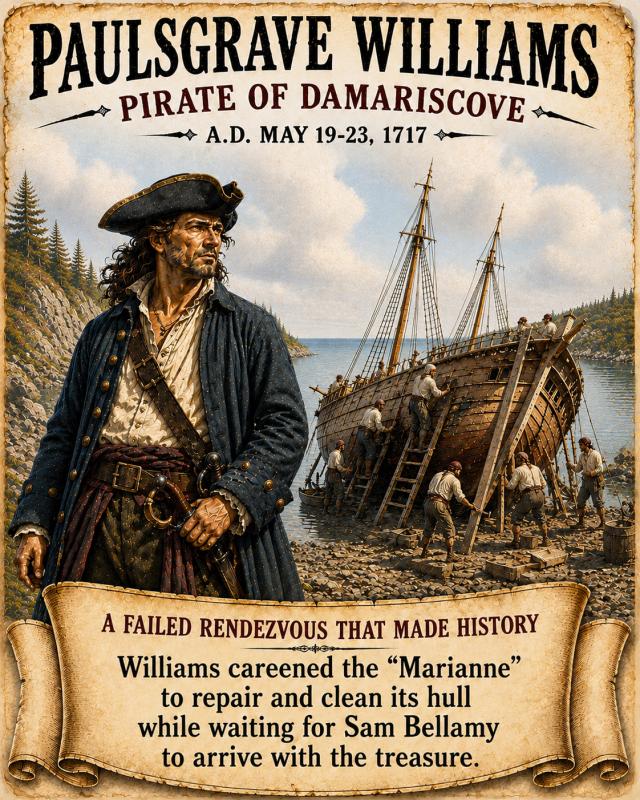
Meanwhile, after visiting family in Rhode Island, Paulsgrave Williams got a late start in his continued northward journey to Maine, also unaware of the Whydah’s fate. Along the way, he raided vessels off Massachusetts seizing materials to overhaul the Marianne. Just northeast of Boston, he captured the fishing sloop Elizabeth - the perfect sized vessel to assist with careening his own, and its captain Paul Mansfield could guide him as far as Richmond Island, Cape Elizabeth.
After their arrival on May 19, a small fishing boat entered the island’s harbor. When asked whether the fishermen knew the way to Damerill’s Cove (Damariscove) and Monhegan, the man who answered “yes” was taken aboard, while the other escaped to report the pirates. Captain John Lane immediately wrote Governor Samuel Shute that a pirate sloop of about ninety men with eight guns was anchored at Cape Elizabeth and states that “they have taken one sloop & one shallop (light, open boat) which they keep with them to clean there sloop.”
Williams soon reached and remained at Damariscove for five days waiting for the Whydah – careening his vessel to clean and repair the hull. Their presence reported in the 1717 Boston newspaper also described another pirate sloop, but Captain Mansfield’s deposition solved the mystery of the misidentified ship. He testified that Williams “...careened his sloop with mine and washed and tallowed her,” and on the evening of May 23, they were released with provisions as stated “….as Satisfaceon for our hindrance, loss of our ffaire (catch of fish), and things taken from us.”
The presence of Bellamy, Williams and Noland along New England’s coast forced colonial officials to take extreme action. Governor Samuel Shute dispatched Colonel Shadrach Walton in pursuit of Damariscove’s pirates, closed Boston Harbor to commerce for one week, sent for naval protection, and hired a privateer to hunt down Bellamy’s cohorts. Shute also spoke to the General Assembly about “the worst of the Enemy’s the Pirates who have insulted our Coast.”
Bellamy never reached the planned Maine rendezvous, but two of his associates did - Noland at Monhegan and Williams at Damariscove - both at different dates. Their recorded movements preserved in depositions, official correspondence, and newspaper reports provide evidence that “Robin Hood of the Sea,” and his men, plied the waters of the Boothbay Harbor region in 1717.
In our next article, you’ll learn about what happened aboard the Whydah during its final hours off Cape Cod, and what remained of Bellamy’s ship and treasure beneath the sea. We’ll focus on the Whydah itself - its wreck, the evidence recovered from the seafloor, and underwater explorer Barry Clifford’s extraordinary discovery more than two and a half centuries later.
Until then, sign up for the Boothbay Harbor Treasure Hunt, which runs until Sept. 30. This win-win event is lots of fun and supports local businesses and “Education Boothbay” - a place-based learning initiative for our region’s schools.